

- You are here:
- Home »
- Blog »
- Best Canon Lens »
- Best Canon Lenses Canon EF 2.0X III
Best Canon Lenses Canon EF 2.0X III
About Best Canon Lenses Canon EF 2.0X III Super Telephoto Lenses
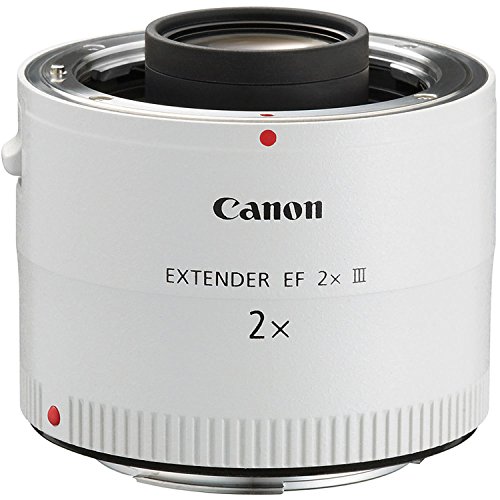
The Best Canon Lenses Canon EF 2.0X III is designed to extend a lenses focal length by a factor of 2x. The redesigned Canon Lenses Canon EF 2.0X III delivers optical performance on par with the finest Canon super telephoto lenses. It features a built-in microcomputer for seamless communication among camera body, lens and extender, features careful lens placement and coatings to minimize ghosting, flare and chromatic aberration, and even has a new Fluorine coating that keeps soiling, smears, fingerprints to a minimum. the Best Canon Lenses Canon EF 2.0X III meets necessary standards in terms of rugged, dustproof and water-resistant construction, and should be in every professional’s camera bag.
Product Features
- Compatible with Select EF Mount Lenses
- 2.0x magnification factor
- 9 elements in 5 groups lens construction
- Spectra coating reduces ghosting/flare
- Dust and water resistant
Session expired
Please log in again. The login page will open in a new tab. After logging in you can close it and return to this page.
Clarifications for interested buyers Things to keep in mind when reading various review.1. There is no such a thing as free lunch. Anyone who claims fast autofocus with this combo is smoking something. Canon white papers claims a 75% reduction in autofocus speed. It will also degrade image quality, no matter what lens you put it on.2. As for Image quality, acceptability, and degradation, there are several factors in play. Of course where you end depends on where you start. used on an optically superb lens, after some image degradation, you can still end up with good image quality. with mediocre lens, you end up with bad, and with a bad lens, you end up with mush. The other factor in acceptability is the image density of the sensor. The image quality will be a lot more acceptable on a 5d2 or 40D for example than the 7D. the higher pixel density of 7D is far more demanding on lens resolution. furthermore, the cropped sensor of same pixel count, greatly magnifies Chromatic aberration.3. In…
Great with the 70-200 F/2.8, on IS II even better I got this to pair with my 70-200mm F/2.8 IS II since I needed a bit more reach, and didn’t want to spring for a 300mm or 400mm lens.I’m extremely happy with it, and have to say that on a high quality lens, like the 70-200/2.8 IS II, there is hardly any loss of functionality at all. Yes, you do lose two stops, but getting a 400mm F/5.6 is not bad at all, and the 4 stops of the IS on the IS II certainly helps a lot. And these days, with the ability to shoot high ISOs without much noise (such as on the 5D3), it’s not an issue getting clear shots at 1/500s or faster during the day.There is some SLIGHT image degradation, to be expected, but it is not noticeable at all unless you are seriously pixel peeping. Only at 100% crops would you be able to tell the difference, and the gain from the extra focal length far outweighs the slight loss in image quality.You do also get slower autofocus, again, because of the reduced effective aperture size (less light…
Canon EF 2.0 Mk III Telephoto Extender To say I was apprehensive of purchasing this tele-converter would be an understatement. After owning the Canon EF 2.0X mk II and being completely disappointed and underwhelmed with it, it took me years to decide to try another 2x extender. After I did purchase it a few weeks back, it even sat in my bag a week or 2 before I decided to pull it out and try using it.With a tool like this, you want to use it for the right reasons and on the right kind of lenses. With that said, I’m using this on the Canon 300mm 2.8mm professional lens. Because the Canon 300mm has a smallish range, I’ve always shot with the Canon EF 1.4 MkII telephoto extender tacked on the back of it. The 300 is such a sharp lens, I lose very little sharpness using the 1.4 tele. Being a bird/wildlife photographer, I am always looking for more and more MM, so I decided to go ahead and try it.So far it’s been everything I was hoping for. Much sharper than the 2.0 Mk II with the addition of new coating on the…